Streamlining Custom Party Decor: A Practical Guide to the Unicorn Cake Topper SVG
In the modern landscape of creative entrepreneurship and personalized event planning, efficiency is not just a buzzword; it is the backbone of profitability and sanity. Whether you are a small business owner running an Etsy shop, a parent organizing a milestone birthday, or a hobbyist looking to refine their crafting workflow, the tools you choose dictate the quality of your output. One such tool that has gained significant traction for its versatility and ease of use is the Unicorn Cake Topper SVG. This digital asset is more than just a cute graphic; it is a functional component in a broader production pipeline that bridges digital design with physical creation.
Understanding how to effectively integrate this file type into your existing workflow requires a shift in perspective. Instead of viewing it merely as a image to be printed, consider it a vector-based instruction set for your cutting machine. The value lies in its scalability, editability, and compatibility with industry-standard software. By mastering the implementation of this specific asset, creators can reduce setup time, minimize material waste, and ensure consistent quality across multiple projects.
The Role of Vector Assets in Modern Crafting Workflows
Before diving into the specifics of the unicorn design, it is crucial to understand why SVG (Scalable Vector Graphics) files are the preferred format for digital cutting. Unlike raster images such as JPEGs or PNGs, which are made of pixels and lose quality when resized, SVGs are defined by mathematical paths. This means you can scale a Unicorn Cake Topper SVG from the size of a cupcake topper to a large wall decal without any loss in resolution or sharpness. For professionals, this flexibility is invaluable. It allows for rapid prototyping and adaptation to different client needs without the need for redesigning the artwork from scratch.
When you download a package that includes an SVG in a zipped folder, you are receiving a clean, layered file ready for decomposition. This structure is critical for multi-color projects or 3D layered designs. In a typical workflow, the preparation phase involves unzipping the folder and importing the file into your design software. This step is where organization pays off. Keeping your digital assets sorted by theme, file type, and project status ensures that you spend less time searching for files and more time creating. A well-organized library of SVGs acts as a reusable resource bank, significantly speeding up future projects.
Software Compatibility and Preparation
The practical utility of any digital asset is determined by its compatibility with your hardware and software ecosystem. The Unicorn Cake Topper SVG is designed to be easy to cut on popular platforms like Silhouette Studio and Cricut Design Space. However, the integration process varies slightly depending on your chosen toolchain.
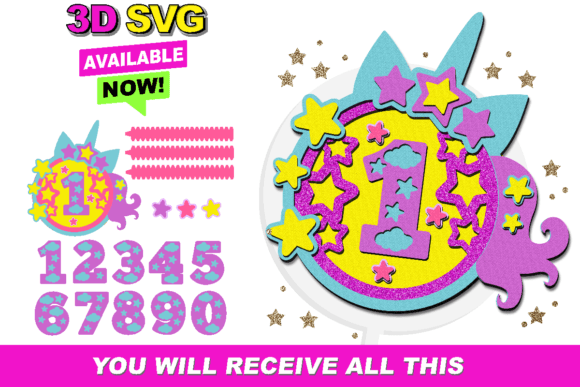
For users of Cricut Design Space, the process is straightforward. After uploading the SVG, the software typically recognizes the layers automatically. This is where the "3D" aspect of the design comes into play. A 3D SVG usually consists of multiple overlapping layers that create depth when assembled. In Design Space, you must ensure that each layer is assigned the correct operation (usually "Cut") and material setting. If you are using cardstock, selecting the appropriate pressure settings is vital to ensure clean cuts without tearing the paper. The key here is verification: always perform a visual check in the software to confirm that all layers are present and correctly aligned before sending the job to the machine.
Silhouette Studio users, particularly those with the Designer Edition or higher, have even more control over the node editing process. If you find that certain curves in the unicorn’s mane or horn are not cutting smoothly, you can adjust the nodes directly within the software. This level of granular control allows for fine-tuning the design to match the specific tolerances of your blade and mat. For those using other types of machines, such as Brother ScanNCut or various laser cutters, the principle remains the same: ensure your software can interpret vector paths. If your machine relies on proprietary formats, you may need to convert the SVG using a third-party tool, but this adds an unnecessary step to your workflow. Sticking to native SVG support wherever possible maintains efficiency.
Execution: From Digital File to Physical Product
Once the file is prepared and the machine is calibrated, the execution phase begins. This is where the theoretical benefits of the Unicorn Cake Topper SVG translate into tangible results. Cutting intricate designs like a unicorn requires attention to detail regarding material selection and weeding techniques.
- Material Selection: For cake toppers, durability and food safety are paramount. Use high-quality cardstock or acrylic if you are laser cutting. Ensure that any adhesives or coatings used are non-toxic and safe for proximity to food, even if they do not directly touch it.
- Cutting Precision: A sharp blade is non-negotiable. Dull blades drag through paper, causing jagged edges that ruin the clean lines of the SVG. Regularly inspect and replace your blades to maintain consistency.
- Weeding Strategy: The term "weeding" refers to removing the excess material from around the cut design. With a complex 3D SVG, weeding can be tedious. Start from the outer edges and work your way in. Use tweezers for small, intricate parts like the unicorn’s eye or horn details. Patience during this stage prevents accidental tearing of the final product.
Assembly is the final step in the physical production process. Since this is a 3D design, you will likely need to layer multiple pieces. Use foam adhesive squares or double-sided tape to create spacing between layers. This spacing creates the shadow effect that gives the topper its dimensionality. Consistency in spacing is key to a professional look. Measure the distance between layers or use pre-cut spacers to ensure uniformity across all units if you are producing in bulk.
Quality Control and Long-Term Usability
Integrating the Unicorn Cake Topper SVG into your routine is not a one-time event; it is an iterative process. Quality control should be embedded at every stage. After cutting the first unit, inspect it closely. Are the edges clean? Do the layers align correctly? Is the structural integrity sufficient to stand upright on a cake? Identifying issues early allows you to adjust your settings before committing to a larger batch. This proactive approach minimizes waste and protects your reputation if you are selling these items.
Furthermore, consider the long-term usability of the file. Save your project files with clear naming conventions that include the date and version number. This practice helps you track changes and revert to previous versions if necessary. Over time, you may want to modify the design—perhaps changing the color scheme for a different theme or resizing it for a different application. Having a well-organized, editable source file makes these adaptations seamless.
For educators and marketers, this asset can serve as a teaching tool or a promotional item. Demonstrating the transformation from a digital SVG to a physical object can engage students or customers, highlighting the capabilities of modern crafting technology. It showcases the intersection of digital literacy and manual skill, a valuable combination in today’s creative economy.
Optimizing Your Creative Pipeline
To truly leverage the potential of the Unicorn Cake Topper SVG, view it as part of a larger system. How does it fit into your content calendar? Can it be bundled with other party decorations for a cohesive product line? Does it complement your existing brand aesthetic? Answering these questions helps you maximize the return on investment for your digital purchases.
Efficiency also comes from batching. If you know you have multiple orders or events coming up, cut multiple sheets at once. Organize your workspace so that materials, tools, and finished products have designated areas. This reduces movement and decision fatigue, allowing you to focus on the craft itself. Remember, the goal is not just to produce a single cake topper, but to establish a reliable, repeatable process that delivers high-quality results with minimal stress.
In conclusion, the Unicorn Cake Topper SVG is a versatile and powerful asset for anyone involved in creative production. By understanding its technical requirements, optimizing your software workflow, and maintaining rigorous quality control, you can transform a simple digital file into a stunning physical product. Whether you are a seasoned professional or a passionate hobbyist, mastering the integration of such assets empowers you to create with confidence, consistency, and creativity. Embrace the process, refine your techniques, and let your tools work for you.